

Across Germany, one in every 10 to 15 women of childbearing age suffers from endometriosis. Nevertheless, it takes an average of 7 to 10 years for a diagnosis to be made. The interdisciplinary EndoKI (Endometriosis and Artificial Intelligence) project aims to improve the diagnosis and treatment of endometriosis with the help of artificial intelligence. It is coordinated by Friedrich-Alexander University Erlangen-Nuremberg (FAU) and carried out by seven project leaders from FAU, Erlangen University Hospital (UKER), Julius Maximilian University of Würzburg (JMU), and the Technical University of Munich (TUM) (further information).
As part of this project, the Chair of Science, Technology, and Gender Studies (STGS) is conducting an ethnographic sub-study to understand the role of knowledge gaps, social structures, and social factors (such as stigmatization, taboos, and prejudices) that cause these delays. Furthermore, the findings from the ethnographic sub-study will be incorporated into the development and implementation of the 3D AI-supported patient model of the overarching EndoKI project.
This research focuses on the following questions: What factors contribute to the delayed diagnosis of endometriosis? How do technology and gender influence current approaches to the diagnosis and treatment of endometriosis? And how can AI-powered technology be designed to meet the needs of people with endometriosis and those involved in endometriosis care?
To answer these questions, the STGS Chair is conducting participant observation—that is, researchers visit relevant settings such as clinics or endometriosis conferences, interview relevant stakeholders including patients, gynecologists, EndoKI researchers, and other relevant experts, and gather information about their experiences with the disease, with their patients, or with the development of the EndoKI 3D AI-powered patient model.
CALL FOR PARTICIPATION!
The EndoKI Ethnographic Study is looking for:
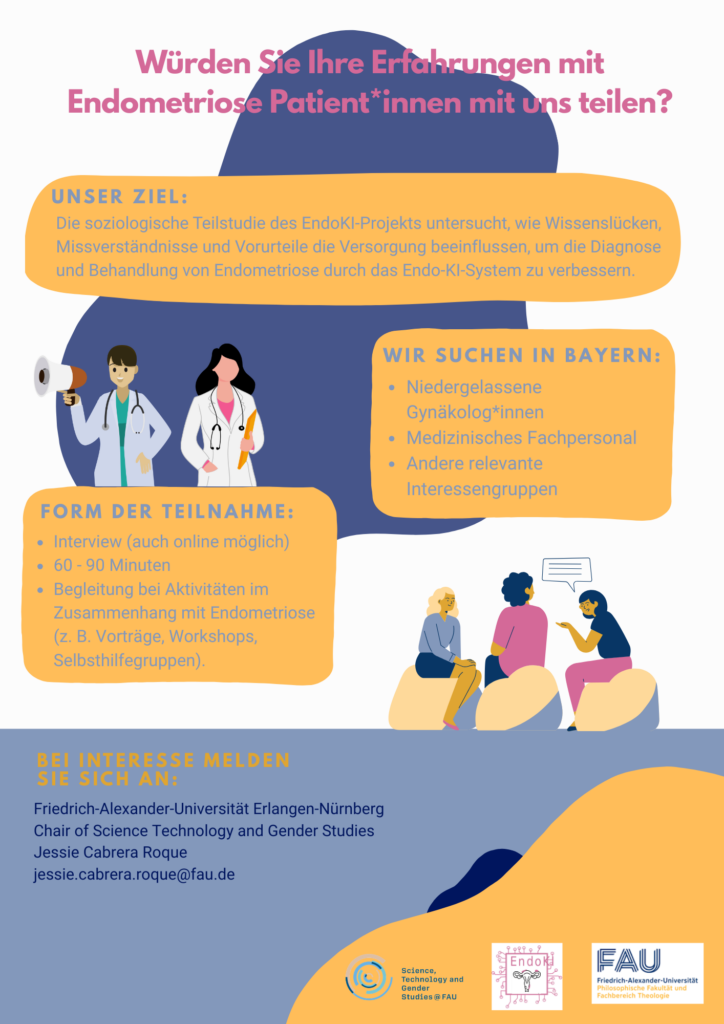
- Professionals related to endometriosis or adenomyosis care
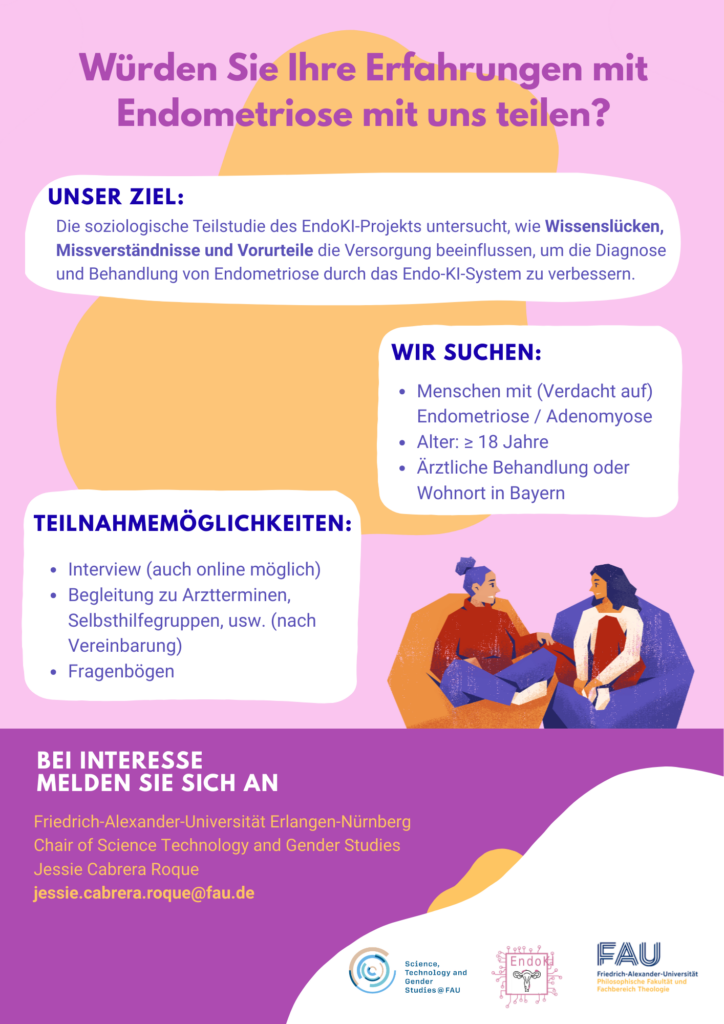
- People with endometriosis or adenomyosis, or a suspicion of having these diseases
Note: Participation is currently only possible in German
Debilitating pain, long paths to diagnosis, and stigma mark the day-to-day experiences of people with endometriosis or adenomyosis. One in ten people assigned female at birth lives with this chronic disease; the average waiting time for diagnosis is 8 years. The EndoKI Ethnography aims to understand the social and cultural dimensions of the disease, which shape its diagnosis and treatment in Bavaria. As part of the overarching EndoKI project, it also focuses on the ethical aspects, risks, and opportunities for the design and implementation of an AI-supported ultrasound tool drawing on the knowledge gained from the ethnographic work.
AUFRUF ZUR TEILNAHME!
Die ethnografische Studie EndoKI sucht:
- Personen mit Endometriose oder Adenomyose oder Verdacht auf diese Erkrankungen
- Fachleute aus dem Bereich der Endometriose- oder Adenomyose-Behandlung
Quälende Schmerzen, lange Wege bis zur Diagnose und Stigmatisierung prägen den Alltag von Menschen mit Endometriose bzw. Adenomyose. Jede zehnte Person, die bei der Geburt als weiblich zugeordnet wurde, lebt mit dieser chronischen Erkrankung; die durchschnittliche Wartezeit bis zur Diagnose beträgt acht Jahre. Die EndoKI-Ethnographie zielt darauf ab, die sozialen und kulturellen Dimensionen der Krankheit zu verstehen, die ihre Diagnose und Behandlung in Bayern prägen. Als Teil des übergreifenden EndoKI-Projekts konzentriert sie sich auch auf die ethischen Aspekte, Risiken und Chancen für die Entwicklung und Implementierung eines KI-gestützten Ultraschalltools, das auf den Erkenntnissen aus der ethnografischen Arbeit aufbaut.